Outrage!
-
The Daily Mail reports on the “outrage” that has followed a recent column
in the JoongAng Daily that suggested the atomic bombing of Hiroshima and
Nagasaki...
15 minutes ago
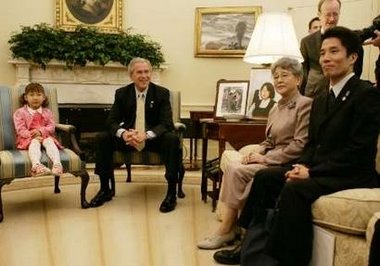
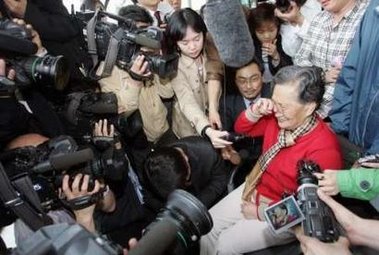
The family of Megumi Yokota, kidnapped by North Korean operatives from her town in Japan in 1977 and focibly taken to North Korea where she presumably was made to teach DPRK spies the Japanese language and culture, has gone to the US capital. 'We strongly will work for freedom so that the people of North Korea can raise their children in a world that's free and hopeful, and so that moms will never again have to worry about an abducted daughter.Along with Megumi's mother and younger brother, Takuya, were four North Korean defectors. These were former military officer Kim Sungmin and a family—a couple and their six-year-old daughter Kim Hanmi—who defected to South Korea via a Japanese consulate in Shenyang, China, in May 2002, in what was a major incident involving the Chinese police rushing into the Japanese consulate—sovereign Japanese territory—in order to retrive the defectors. Japanese Prime Minister famously demanded that China "give us back our North Koreans" (or something like that), something that impressed me about the PM.

My reader believes that when you add to the outrage following this incident and that of the poor treatment of Korean employers toward their Vietnamese workers, as well as the unforgotten atrocities committed by Korean soldiers during the Vietnam war, it all makes for some very ugly international relations. (He also noted that the war accusations weaken Korea's case against Japan).Sadly, in Korea, the issue of ROK participation in the Vietnam War was something that that generation didn't want to address. Many ROK men lost their lives, many more were maimed by Agent Orange, quite a few suffered post-traumatic stress from what they saw (and maybe what they did) in Vietnam. It was something shameful and unpleasant that most preferred to leave in the past.
During a visit to Hanoi in 1998, South Korean President Kim Dae-jung expressed regret over Korean actions in the Vietnam War, but he did not apologise. Vietnam responded by saying it sought no apology from any nation that fought on its soil. Long-time Vietnam watchers say Hanoi does not like to highlight specific horrors from decades of wars against the French and then the U.S.-backed South Vietnam.In more recent years, private Korean groups, especially among the so-called "progressives," have gone further:
Some of the memories of atrocities committed during the Vietnam War are being laid to rest today with the opening of a peace park in the south of the country. It has been largely funded by South Koreans through a newspaper, the weekly Hankyoreh 21 or People 21, which has exposed atrocities committed by South Koreans during the war.Given Korea's involvement in Vietnam, I think it's a fair question to ask if Korean authorities, Korean institutions, and Korean individuals are living up to responsibility for atrocities in the same way so many Koreans demand of Japan.
Carl Thayer, an expert on Vietnam at the Asia-Pacific Center for Security Studies in Hawaii, said the killing of civilians by Koreans had largely faded from view because the Vietnam War was mainly seen as an American war. "Vietnamese propagandists always make a distinction between the American government and the American people,'' he said. "In their view the Vietnam War was a war launched by a wicked government. Koreans, Thais and Australians were all lackeys. "It is easier to point the propaganda finger at one enemy, several only clouds the issue,'' he said.Korea should not be given a free ride on things in which its leadership or its citizens willingly participated. For too long the taboo and shame has kept people silent, but the same people who have brought us the "truth commissions" about military-era cronyism and occupation-era collaboration also want to shed light on this:
A new space for examining the Korean national identity and culture is emerging. A small number of “386” activists and academics is looking inward and confronting the once dormant and tabooed subject of crimes committed by the troops of South Korea’s authoritarian regime outside its national borders. The topic that has generated so much discomfort and tension lately centers on the little-known historical fact that South Korea was a Cold War enemy of Vietnam. It has come to light that the 300,000 Korean troops that fought against North Vietnam from 1964 to 1973 as U.S. “mercenaries” allegedly killed thousands of unarmed Vietnamese civilians.So, yes, the issue is being addressed, and there has been official expression of regret. Arguably, though, more needs to be done, but at the same time, people should know the facts before they start pointing the finger.
The consideration of this taboo topic of the Korean troop actions during the Vietnam War has created new inter-Asian political conflicts and alliances: charged clashes inside South Korea between Korean veterans and activists; [End Page 621] activist-led investigations of Korean troop massacres of Vietnamese civilians; reflection on the role of Korea as a perpetrator, not only as a victim, of war crimes; and cross-national and cross-cultural dialogues between Korean and Vietnamese citizens. The current public discussions at the local and national levels are fraught with controversy, but they are also promising because they may shed light on Korea’s complicated position in the global, neocolonial world, especially its regional position in Asia.
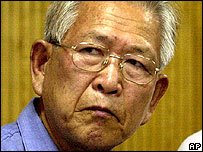
Japan has asked North Korea to hand over this man, Sin Guangsu. Tokyo believes Sin helped to abduct a Japanese man named Tadaaki Hara in 1980. Mr. Hara, believed to be dead now, was forty-three years old at the time. Japanese police investigations suggest he was tricked by two men who said they had a job offer for him. It is thought he was kidnapped and taken to North Korea by boat.
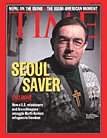
The second-most influential entertainer in the world is not the only Korea-related topic in Time Magazine this week.
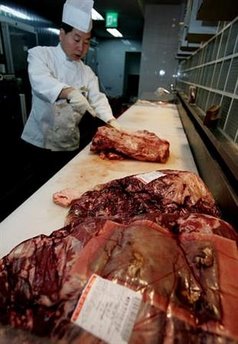
[photo: Beef is yummy. Alternate Simpsonian caption: More testicles mean more iron!]
South Korean pop singer Rain (at left with "Star") was ranked the second most influential figure in the global entertainment industry, according to a poll by Time.
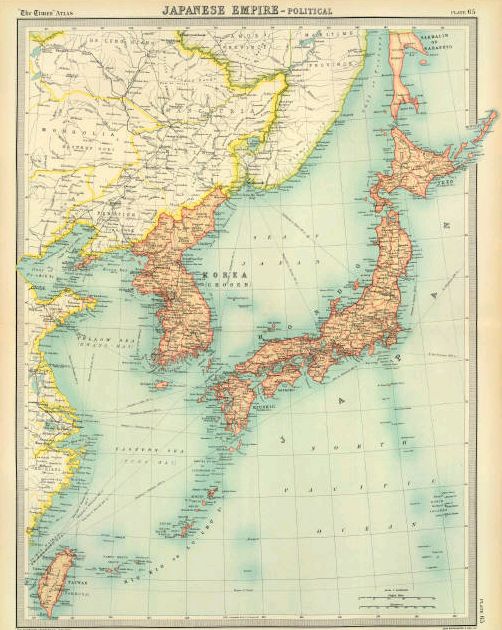
In fact, however, even just before the defeat in 1945, Imperial Japan was still committed to a policy of “reserving Korea to Japan,” i.e., retaining Korea as a Japanese colony: these facts are clear from documents made public by the Japanese government. (See the section “Territory to Be Yielded” in the document “Policy on Negotiations with the USSR,” dated May 14, 1945, drawn up by the Supreme War Leadership Council.)++ To ignore these facts and describe Imperial Japan as if it had been a leader in the liberation of the colonies is to distort history, to construct a “modern myth.”My point here is not to dredge that up, since it has long been a matter of public record. Rather, the whole situation got me wondering about what would have happened had a defeated Japan succeeded at "reserving Chōsen (Korea) to Japan."
++The Supreme War Leadership Council was established in August 1944. Its members were the Prime Minister, the Foreign Minister, the Army Minister, the Navy Minister, and the Chiefs of the Army and Navy General Staffs. The Showa Emperor also attended the meetings when important matters were discussed. The section “Territory to Be Yielded” stated that in order to succeed in its negotiations with the U.S.S.R, Japan would need to begin to prepare to return Southern Sakhalin to the Soviet Union, renounce fishing rights there, re-open the Straits of Tsugaru (between Honshu and Hokkaido), and cede Japanese railroad rights in Northern Manchuria; Japan, however, would retain Korea.
For my thoughts on the current nonsense from Roh's latest salvo, in which he apparently re-declared "diplomatic war," see this post from last spring.
According to the American Chamber of Commerce in Korea, 627,000 Korean visitors to the US in 2004 spent an average of $3500 per trip. Plus over 57,800 Korean students studying in the US, Korean nationals contribute a total of $ 2.2. billion in tourism revenue to the US. A report by the U.S. Department of Commerce predicts these figures could double if Korea entered the US Visa Waiver Program. 
I just happened across this the other day, and it was just to good to wait two months to post.
Sphere: Related Content
Reuters has this video clip on Kyŏnggi-do Province's [Gyeonggi] recently opened "English Village" in P'aju [Paju], north of Seoul.
An inside joke, perhaps, but this configuration of the comments on The Marmot's made me laugh:
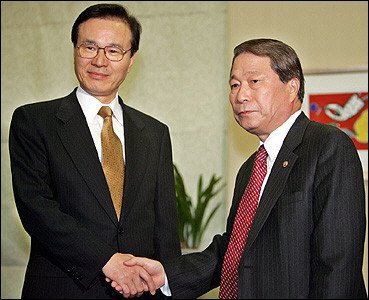
Japanese Vice Foreign Minister Shotaro Yachi and his delegation made an emergency trip to Seoul last Friday, meeting with South Korean Fice Foreign Minister Yu Myung-hwan [Yu Myŏnghwan] to try to break the impasse triggered by Japan's plan to send survey ships into the disputed waters. South Korea responded twenty gunboats to the area, warning of a possible physical confrontation if Japan proceeded.
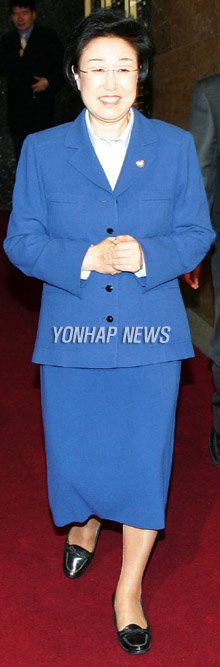
And so I'm going to make such a prediction: Prime Minister Han Myŏngsuk (does she spell her name Han Myung Sook? Not sure, but I'll leave that in there for googling purposes) will be Korea's next president.
I'll try to go to church next week. Frankly, I think the pastor/priest at whatever religious institution I choose to attend next week will be thrilled to see someone help filling the pews the week after Easter, what with so many people only going to church on Christmas and today.
Anyway, I am so sick of stupid-ass White people telling stupid-ass Asian people how it's the Koreans, the Japanese, or the Chinese, or the freakin' Hmong who are the most racist. I'm also sick of stupid-ass Asian people doing the same thing to stupid-ass White people. And I'm really sick of stupid-ass Black people NOT calling everyone else onto the carpet and saying, "You're all a bunch of messed-up, race-baiting muther fuckers."
[at left: The logo for Stormfront. I happened across their site one day while searching for do-it-yourself small-business shop maintenance equipment when I mistyped "storefront." While I certainly don't agree with their politics, I do think they have a smart-looking logo. Plus their slogan rhymes. That's bonus points when you're trying to attract an army of simpletons.]
I will use a comprehensive source to mine for stated opinions on racist experience. This is actually quite simple using Google, which has cached every single thing ever uttered on-line. By searching for the string "[plural form of nationality] are the most racist," we can count the number of times such a sentence was uttered and saved for on-line viewing.
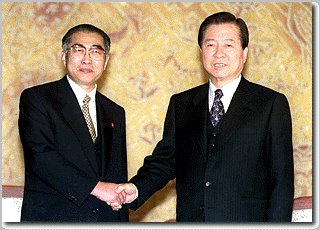
Nevertheless, these two forward-thinking statesmen knew that the best way to look to the future was to take an honest look at the past. It was no small concession for either that they came up with a comprehensive declaration that would light the way to a better tomorrow. The two leaders shared the view that in order for Japan and the Republic of Korea to build solid, good-neighborly and friendly relations in the twenty-first century, it was important that both countries squarely face the past and develop relations based on mutual understanding and trust.Sadly, Mr. Obuchi became deathly ill, suffering a stroke and lapsing into a coma, eventually dying. He was replaced by a man said to have "the heart of a flea and the brain of a shark," and his successor's successor seemed to scoff at the plans he had made with his friend, Mr. Kim, who long ago had sought refuge in the Land of the Rising Sun. For his part, Mr. Kim's term of office ended and he was replaced by a man with about as much sense of statecraft as a court jester. Both of these "leaders" chose to pander to nationalistic sentiments, one on the left wing and the other on the right wing, in a bid to bolster their position by seeking support from the vocal fringe.
Looking back on the relations between Japan and the Republic of Korea during this century, Prime Minister Obuchi regarded in a spirit of humility the fact of history that Japan caused, during a certain period in the past, tremendous damage and suffering to the people of the Republic of Korea through its colonial rule, and expressed his deep remorse and heartfelt apology for this fact.
President Kim accepted with sincerity this statement of Prime Minister Obuchi's recognition of history and expressed his appreciation for it. He also expressed his view that the present calls upon both countries to overcome their unfortunate history and to build a future-oriented relationship based on reconciliation as well as good-neighborly and friendly cooperation.
Further, both leaders shared the view that it was important that the peoples of both countries, the young generation in particular, deepen their understanding of history, and stressed the need to devote much attention and effort to that end.
In a radio interview Gen Riggs, a former division commander, said it was time for Mr Rumsfeld to go because he fostered an atmosphere of "arrogance" among the Pentagon's top civilian leadership.The six retired generals who have chosen to spoke out recently are Army Major General Charles H. Swannack Jr., Army Major General John Riggs, Army Major General John Batiste, Marine General Anthony Zinni, Marine Lt. General Gregory Newbold, and Army Major General Paul Eaton. Some of these are names you may recognize from the news, such as Zinni, Riggs, and Batiste.
"They only need the military advice when it satisfies their agenda. I think that's a mistake, and that's why I think he should resign," he told National Public Radio (NPR).
Out of thousands and thousands of admirals and generals, if every time two or three people disagreed we changed the secretary of defense of the United States it would be like a merry-go-round.My first thought on reading this was, are there really thousands and thousands of admirals and generals in the US military, retired or still serving? My second thought was that these "two or three people" (actually, six) who were heavily involved in the US military effort in Iraq may represent a sizable portion of the military brass involved in the war over there (though theirs might still be a minority opinion).
Rumsfeld twice offered to resign in the wake of the 2004 uproar over the Abu Ghraib prison scandal, but Bush refused to accept. He stressed that under Rumsfeld's guidance, the US military has undergone a period of rapid transformation and faced a series of major overseas conflicts.

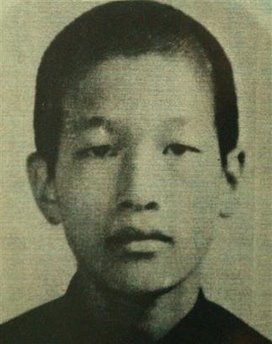
The young man at left is Kim Young-nam [kim yŏngnam, 김영남]. This is a picture of him taken when he was still a kid. I can't show you a picture of him now, as an adult, because in 1978, when he was a high school student, he was kidnapped by North Koreans and forced to live there (a Seoul newspaper alleges that his likely abductor, Kim Gwang Hyun [kim kwanghyŏn, 김광현], is now living in Seoul where he runs a business).


These two families, though utter strangers until this month, are tied together. Not just by their granddaughter (who bears a striking resemblance to her mother) and the marriage between the two reluctant residents of the DPRK. Both families are reminders that North Korea's antics affect many South Koreans and Japanese even today, and these problems must be resolved as well. Perhaps the two families can meet, once in Seoul and once in Tokyo, to make a collective appeal for the ROK and Japanese authorities to get to the bottom of what happened to their daughter and son.
Sphere: Related Content